
Money
Two stages, and only one of them is quoted up front
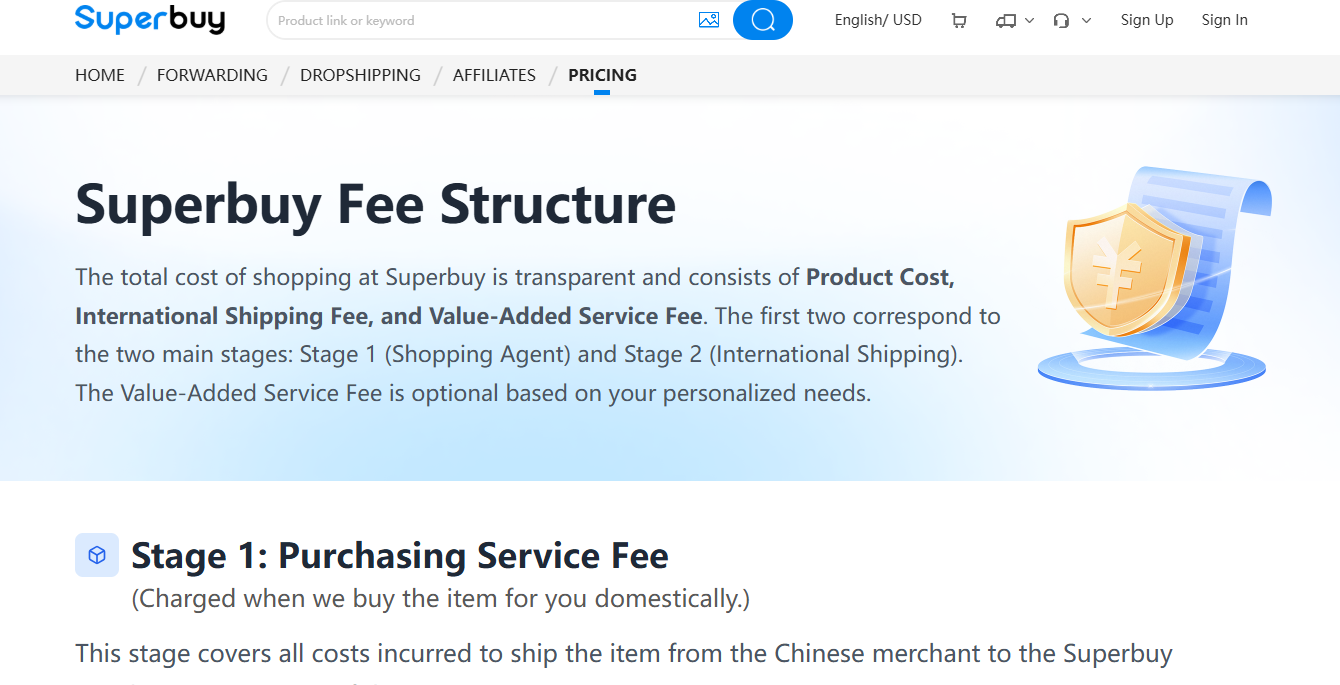
Superbuy splits the cost of an order into two stages and says so on its fee page. Stage one is everything up to the warehouse: the item, the seller domestic shipping, and a purchasing service fee that depends on which platform the item came from. Stage two is the international leg, and it does not exist as a number until there is a box.
This is the single most useful thing to understand before your first order, because people routinely read the stage one total as the price of the order and are surprised twice.
The purchasing service fee, by where the item comes from
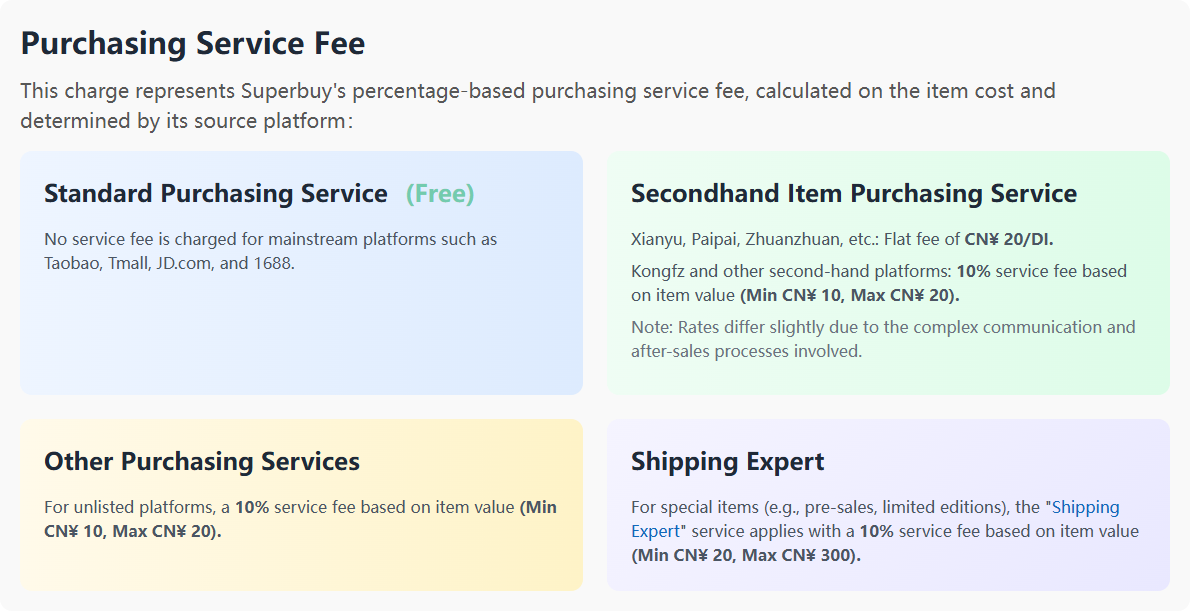
This is stage one, and the rate is set by the source platform rather than by the item. The free row is the one most people are in and never notice.
| Where the item is from | Service fee | What that means for a haul |
|---|---|---|
| Taobao, Tmall, JD.com, 1688 | Free | Nothing is added per order, so splitting one shopping trip into four orders costs nothing at this stage. |
| Xianyu, Paipai, Zhuanzhuan | Flat CN¥20 per item | A flat fee per item punishes buying four cheap secondhand things and rewards buying one expensive one. |
| Kongfz and other secondhand | 10%, min CN¥10, max CN¥20 | The cap means the fee stops mattering above 200 yuan of item value. |
| Platforms not on the list | 10%, min CN¥10, max CN¥20 | Same shape as above. The cap is the part worth remembering. |
| Shipping Expert items, such as pre-sales and limited editions | 10%, min CN¥20, max CN¥300 | A much higher ceiling, because this is the service that goes and gets something difficult. |
Quoted from the Superbuy fee structure page, read 2026-10-10. The same page gives a worked example for stage one: an item at CN¥100 with CN¥10 domestic shipping and CN¥3.00 of detailed photos comes to CN¥113.00, with a zero service fee because it is a mainstream platform.
The storage clock, and the sentence at the end of it
The fee page carries the storage policy in a grey box under the worked example, which is where almost nobody reads it. Ninety days free from arrival. After that, a tenth of a yuan per item per day. Maximum 180 days.
Then the sentence that matters: with no shipping order submitted and no feedback after 180 days, the item is considered abandoned and disposed of. That is not a storage fee, it is a deadline, and the only way to move it is to buy the Extend Storage Period service in advance.

Which exchange rate you are actually paying
Everything upstream is priced in yuan. The item is in yuan, the domestic leg is in yuan, the service fee is in yuan, the packing menu is in yuan, and the freight is quoted in yuan. The only figure that is not is the one your card is charged.
So the conversion happens once at the interface, so the estimate means something to you, and once at your bank or wallet, which applies its own rate and its own cross-border fee. A dollar total on screen is an estimate of what you will pay, not the figure that will appear on your statement.
We are not going to print a markup percentage, because measuring one honestly means running the same basket through several agents on the same day and we have not done that for Superbuy. What you can do cheaply is note the quoted total before you pay, note what actually left the account, and compare both against the mid-market rate for that day. Do that once and you will know this agent conversion better than any article will tell you.
Stage two, with the agent’s own worked example
The fee page carries one worked example for the international leg, and it is worth reading closely because it shows the shape of the bill rather than the size of it. A 1000g parcel on the Hong Kong UPS Economy (Tax-Free) line.
Notice what moves and what does not. The first 500 grams cost six times what the next 500 cost, which is the whole argument for consolidating: the expensive part of a parcel is the fact that it is a parcel. Customs clearance is a flat line item. Fuel and operation are zero on this example and will not be on every line.

| Component | This example | What it means for a haul |
|---|---|---|
| Initial weight shipping fee | CN¥320 for the first 500g | Charged once per parcel. Two parcels means paying it twice. |
| Additional weight shipping fee | CN¥50, per additional 500g | The marginal cost of adding things. Far below the first-weight rate. |
| Customs clearance fee | CN¥38 | Flat on this line. Another per-parcel cost, not a per-item one. |
| Fuel surcharge | 0% | Zero here. It is a percentage, so it scales with everything above it. |
| Operation fee | 0% | Zero here. Same shape as the fuel surcharge. |
| Stated total | CN¥428 | ⚠️ The three charged components above add up to CN¥408. The page does not say what the remaining CN¥20 is, and we are not going to guess. |
Quoted from the fee structure page, read 2026-10-10. We have left the discrepancy in rather than quietly correcting it: a guide that tidies up its source is a guide you cannot check. Run the agent’s own shipping calculator for your own parcel and treat this table as the shape of the bill, not the amount.
Next step.
- The packing menu is the only part of stage two you choose directly.
- Help and FAQ has the glossary and the official support routes.